- Parent Category: Pendulum Products
GPS PicoReference Pico Second Resolution Test Set
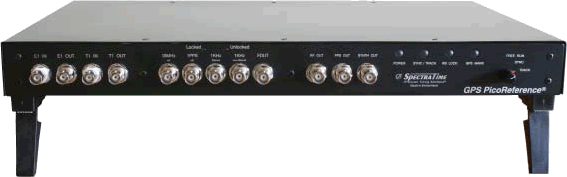
- Rubidium frequency reference
- GPS disciplined
- PicoSecond resolution
- Clock characterization such as quartz crystal oscillator, Rubidium atomic clocks and cesium clocks
- Complete calibration test set
GPS PicoReference Pico Second Resolution Test Set
The GPS PicoReference™ is a low-cost, high-performance frequency reference and measurement test set. It integrates a smart GPS and a Rubidium reference, features a flexible 1-30MHz frequency testing range and a cutting-edge 1 ps measurement resolution. It’s ideally designed for clock characterization and calibration applications.
PicoReference Product Characteristics:
- GPS disciplined Rb clock: Auto-adaptive SmarTiming
- Compact: 1U rack mount chassis
- Testing Frequency Range: 1-30 MHz
- Reference Frequency: Integrated GPSlocked Rubidium clock
- Phase time resolution and noise: <2ps rms
- Output Frequency : 4x 10MHz/4x 1PPS or 8 x 10 MHz
- User programmable SYNTH output
- Integrated smart auto calibration
For More Detailed Specifications about this Product Please Navigate to Pendulum Official Website or simply Click Here
| Desctiption | Size |
|---|---|
| Pendulum GPS PicoReference Data Sheet | 419Kb |
- Parent Category: Pendulum Products
GPS-88 GPS Metrology Frequency Standard
GPS-89 GPS Metrology Rubidium Frequency Standard
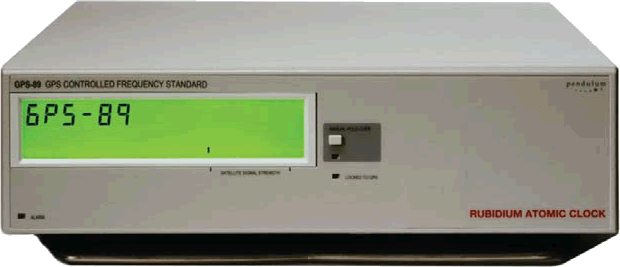
- Traceable internal calibration system approved by SP
- No calibration cost – ever
- Remote monitoring via Ethernet interface
- Cesium stability – at budget price
- No doubt about accuracy, display of frequency offset
- Standard frequencies for telecom, calibration and test systems
Traceable Accurate Frequency Standards
The GPS-controlled frequency standards are especially suited for use in calibration departments, providing continuous traceability with no need for external calibration. The stability/24h is excellent; one part in a trillion.
Long-term frequency stability is provided from the built-in Cesium-controlled standards in the GPS-satellite. Very high short-term stability comes from the built-in oven controlled crystal oscillator found in the GPS-88; or the built-in Rubidium atomic clock installed in GPS-89, as its local oscillator.
Unlike other GPS-disciplined oscillators (GPSDO), the disciplining process is not hidden to the user. We have incorporated a high-resolution phase comparator, which continuously compares the local oscillator with the GPS transfer standard. The result of that comparison is stored internally and can be transferred on demand to a PC. The frequency offset is displayed on the front panel and
the values are stored in NVRAM for a period of at least 2 years. Now you can remotely read the status of your frequency standard, get phase- or frequency deviation data, print calibration reports and much more via the optional Ethernet communication interface!
Via the GPSView SW, calibration protocols based on the internally stored calibration data can be generated at any time. Standard frequencies are 1 pps, 10 MHz and 5 MHz. Other reference frequencies, for example 2.048 MHz are available as options. We are continuously developing options and accessories, like outputs for new frequencies, distribution amplifiers etc.
Please request the test report from the Swedish National Testing and Research Institute (SP), which verifies the outstanding stability and traceability of the GPS-89: SP-report.
Note! The GPS-88/89 are available for sales in all countries in the world, except USA/Canada.
For More Detailed Specifications about this Product Please Navigate to Pendulum Official Website or simply Click Here
| Desctiption | Size |
|---|---|
| Pendulum GPS-88-9 Data Sheet | 460Kb |
- Parent Category: Pendulum Products
TO-16 Tracking Oscillator

- Low phase noise outputs - even from noisy input reference
- Four outputs phase locked to Reference input
- Autosensing frequency input 5 or 10 MHz for application flexibility
- 5 or 10 MHz outputs can give input frequency doubling or halving
- Good holdover performance if input signals source fails
- Built in test and remote control and monitoring
TO-16 Tracking Oscillator Overview
The TO-16 is a high quality Frequency Reference source that faithfully tracks the frequency accuracy of its reference input. By using a unique conditioning algorithm, the TO-16 senses the input frequency it is supplied and adjusts the frequency of its own ovenised, low phase noise oscillator to maintain frequency and phase coherence. Thus the product can be used to restore the quality of a frequency signal degraded by transmission over long and noisy lines, or to improve the intrinsic noise level of a signal coming from a Rubidium atomic oscillator.
The TO-16 could be also used as a frequency translator between 5MHz and 10MHz, ensuring high signal quality, phase lock and constant tracking.
Low-noise and High Stability
Due to its highly stable internal oscillator, the TO-16 has excellent hold over capabilities if the input signal is lost for any reason. All four sinewave outputs will be maintained with minimal drift until the reference signal is restored. As with all aspects of the TO-16 operation this is detected automatically and frequency conditioning restarted. Initial product start up and recovery from power failures all require no operator intervention or assistance.
Frequency Doubling or Halfing
A useful feature of the TO-16 is that it can be used to perform frequency conversion operations within a system. This means that a standard TO-16 unit will produce outputs at 10 MHz regardless of whether the synchronizing reference is 5 MHz or 10 MHz. When fitted with the relevant option, the TO-16 will produce 5 MHz outputs regardless of whether the synchronizing reference is 5 MHz or 10 MHz. Unlike synthesized outputs, these frequency converted signals from the TO-16 come directly from the on board low phase noise oscillator and so are not subject to the noise and spurious signals often associated with synthesized outputs.
Flexible Remote Control and Monitoring
In addition to front panel indications of status, the TO-16 has a fully featured RS232 bi-directional interface to permit remote Control and Monitoring. This may be by direct serial port connection, or by use of Pendulum Ethernet interface, via a remote web browser. Built in test in the TO-16 ensures that all critical unit parameters are kept under constant observation and that exceptions are rapidly reported.
For More Detailed Specifications about this Product Please Navigate to Pendulum Official Website or simply Click Here
| Desctiption | Size |
|---|---|
| Pendulum TO-16 Data Sheet | 98Kb |
- Parent Category: Pendulum Products
6688 Stand-alone Frequency Standard
6689 Stand-alone Rubidium Frequency Standard
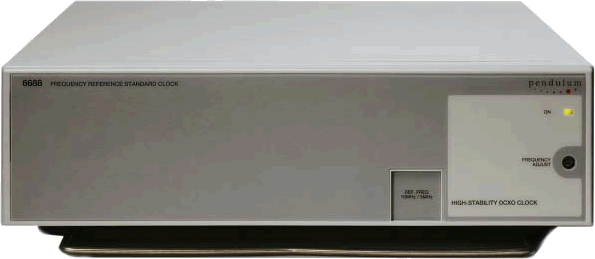
- Rubidium or high stability oven frequency reference standard
- Distribution amplifiers for 5x10 MHz and 1x5 MHz outputs as standard
- Optional 10x10 MHz outputs
- 0.001 ppm aging in 10 years (Rubidium)
- Ideal for telecommunication test systems and calibration laboratories
Ideal Reference for Multiple Testers
The frequency standards from Pendulum suit the highest demands for stability. All frequency standards offer multiple buffered outputs (5x or 10x outputs of 10 MHz sine). Choose from the low-cost 6688 based on a very-high-stability oven-controlled SC-cut crystal oscillator or the 6689 with a built-in Rubidium atomic clock. These standards are suited for use in automatic test systems, for example in the production department of telecommunications
companies, especially when multiple instruments/testers need to be supplied with a stable frequency reference. The very short warm-up time of only 10 minutes makes these units suitable also for field use.
- Up to 11 other instruments can be supplied
- Both 10 and 5 MHz always included
- Portable ultra-stable Rubidium standard takes the stability to any desired location
For More Detailed Specifications about this Product Please Navigate to Pendulum Official Website or simply Click Here
| Desctiption | Size |
|---|---|
| Pendulum 6688-89 Data Sheet | 166Kb |